
This is an article which could often be written about most tram systems across the UK, but this time we report on the Blackpool Tramway who have started February 2026 with a shortage of available trams meaning an already reduced service has seen further cancellations.
As you will recall the tramway has been operating a temporary timetable since 7th January 2026 to allow for essential maintenance work to take place on the Flexity2 trams. This was said at the time to accelerate planned maintenance after a routine inspection found that some trams needed more urgent upgrades to their suspension systems.
This temporary timetable needs nine trams to operate it, out of a total fleet of 18 (although 005 is a long-term absentee). However, at times in the first week of February 2026 even this has not been possible with, at one stage, 11 of the trams being unavailable for service leaving just seven to operate the service as well as the continued driver training programme.
Things have improved since then and as at Friday 6th February the status of the trams were:
Operational: 001, 002, 003, 006, 008, 009, 011, 013, 014, 015, 016
Out of service: 004, 005, 007, 010, 012, 017, 018
Included in the out of service trams is 012 which has also just lost its Pleasure Beach advertising wrap to return to fleet livery for the first time since August 2023.
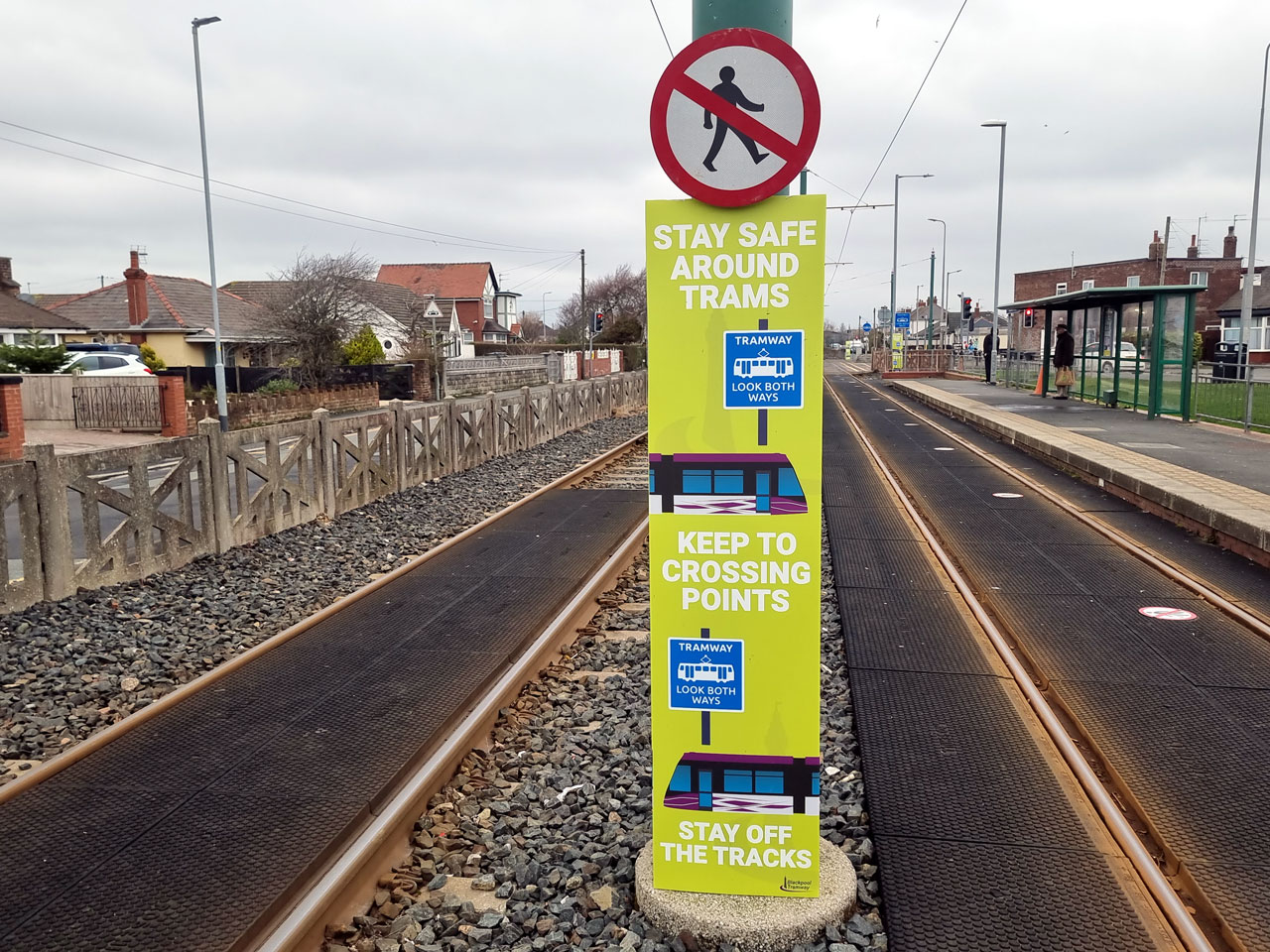
New safety signage continues to be used across the tramway. This includes this new style signs which go further than the “TWO LINES = STOP” LRSSB backed campaign to make it clearer. This is at Broadwater. (Photograph by Michael Morton, 5th February 2026)
Oh dear! Not a good sign, considering that Blackpool was apparently ‘Tramway of the Year, 2025.’
An even worse sign is that, according to a local newspaper, Blackpool Council, already massively in debt, needed to find £500k or thereabouts to pay BTS’s outstanding bills for a single month, earlier this year.
What price the intended new fleet of all-singing all-dancing electric buses now?
Oh, no, not echoes of the ill fated Coronations! I hope not, but the original 16 of the Flexities have had a demanding fourteen year stint in operation. The refurbished double decks could have helped maintain some sort of service, perhaps.
Both Metrolink and West Midlands replaced their original fleets after 15 years or so. Blackpool will soon be approaching a situation where the same procedure might be necessary.
Modern LRVs are usually sold on the premise that they last two or three times the lifespan of a bus. Well that doesn’t seem to have happened on any of the LRV systems except for Sheffield. I’m reminded of when Joe Franklyn took over from Walter Luff in Blackpool. Luff had always wanted everything as modern as possible and in the process commissioned the horrendously overly-engineered Coronations. Joe saw sense and immediately pressed the Balloons back into front line service and started ripping out VAMBAC equipment from Coronations and retro-fitting more rugged traditional gear. Whatw e need now in Blackpool is Joe, not another Walter.
Dump the dead LRVs in Rigby Road and re-commission the B-fleet. It’s so obvious a 5 year old could work it out.
Yes – it’s exactly what a 5-year-old would do…
However, any adult with common sense who had actually read and understood RVAR legislation would know and do differently…
An interesting, and well argued, proposal. It would be interesting to learn what other commentators, preferably knowledgeable and enthusiastic, think?
Perhaps if your 5 year old was in a wheelchair they wouldn’t agree.
Modern LRVs are generally specified with a book life of around 30 years with a midlife refurbishment. The Midlands Metro T69s were replaced because they weren’t compatible with the gradients and curves on the city centre lines. The Metrolink T68s were planned to go through a midlife refurbishment at around 15 years old. However when the scope of work needed was investigated it was found that several of them were suffering from severe corrosion that would have been both difficult and expensive to repair. The initial proposal was to replace those units with new M5000s and indeed one of the early batches of M5000s was ordered for that reason. The rest were to be refurbished. However costings eventually confirmed that replacement gave better value for money along with the benefits of fleet standardisation. Availability of spares for both batches of T68 and T68A were becoming virtually unobtainable mainly because modern electronics become obsolete extremely quickly. The T69s were also suffering the same obsolescence problems as they shared traction electronics as the T68As.
Blackpool won’t get any money.
The first question will be why the B fleet weren’t used as extras to lighten the load (Dft paid don’t forget).
I’d suggest replacement with trolleybuses will be the option within the next 10 years.
So they went for the cheapest option (despite recommendations) and didn’t buy enough (arguable they would have had enough if the B fleet had run a Promenade service). Exactly what happened with the T68 and T69 trams.
Also the CBA doing it properly ethos seems to have transferred across to the new system……..
Easy to forget that Manchester, Croydon and Nottingham have also suffered heavily with vehicle shortages in the last 12 months or so. Not a problem unique to Blackpool at all, yet those three systems dont seem to attract the same level of negativity?
I don’t recall ever reading that some one third of the fleets of Manchester, Croydon, and Nottingham were out of service at the same time, however.
That isn’t ‘negative’ it is simply a comment on factual information.
For Metrolink you have to dig quite deep into the GMCA reports to find it, vehicle availability targets get missed almost daily, some days by a lot. Both Nottingham and Croydon had heavily reported service reductions due to vehicle availability, with Croydon down just 8 serviceable vehicles out of 34 at one point. All self contained networks are vulnerable to it and always will be.
I would be very interested to hear where you find the vehicle availability targets within the agenda packs for the GMCA Bee Network Committee meetings. The only performance data I have been able to find is for overall Metrolink reliability on a 4 week period basis. I would be genuinely grateful if you could point me in the right direction to find the data. Thanks in advance.
You clearly don’t recall the premature demise of the T68 and T69 vehicles and many patch up repairs just to get enough out!
I don’t know where you get your information regarding Metrolink from but as a former member of the engineering team I do know that the T68 problem was not reliability based, it was simply poor build quality and a desire to standardise on a single design across the expanding fleet that were the driving forces behind the withdrawal of the T68s. As for patch up repairs that is a an urban myth.
The B Fleet, I fear, are in the main falling to bits at Rigby Road and the majority of these would require at least some amount of work to return them to service if not indeed extensive rehabilitation. I suspect that 700 alone could readily be prepared for service at short notice; just maybe also 718. No real benefit overall, especially when a bus can be called upon at the drop of a hat to run a replacement service.
Nostalgic – are you joking? Services cancelled all over the place with no replacement buses last year. have a word with yourself. They haven’t enough drivers to cover sickness on the buses never mind Trams.
And you get “best of the year” and an OBE for this calibre of fleet management!
You really couldn’t write it!
To be fair, she is retiring. In her place, I would probably be keen to do the same. Even without the OBE!
I’m sure many already know this, but ‘Tramways and Urban Transit’ for March 2026 included an interview with Jane Cole, OBE.
I will not comment further, as my opinions might be considered less than impartial!